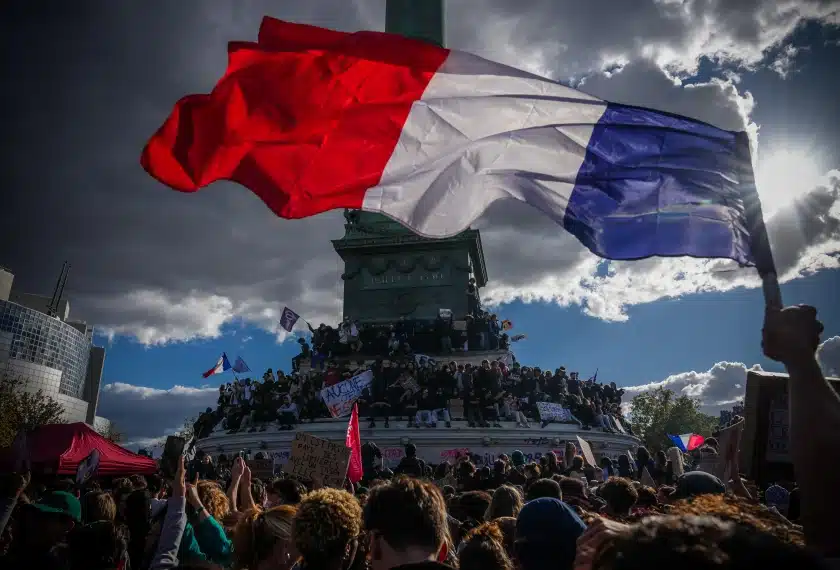
For decades, European imperialists have been trampling on hard-won rights at will through the sham “democracy” known as the European Union and its carefully polished institutions, using deception and window dressing to make even the most anti-people policies palatable. This time, however, they have come up against a formidable obstacle. And they are only at the beginning of this latest wave of defiance.
“Don’t you dare,” warned Devlet Bahçeli. Tayyip Erdoğan subsequently issued much the same warning. The message from Turkey’s rulers was unmistakable: no one should contemplate staging protests of the kind now taking place across Europe.
Neither said a word about the protesters’ demands. Of course, the Turkish government can hardly object to turmoil in France. Paris has long frustrated Ankara’s foreign policy ambitions. But naturally, Erdoğan and his allies cannot admit their satisfaction openly. The pro-government press has tried to explain the protests through everything from the breakdown of the family to Islamophobia. Yet the real concern lies elsewhere. Protests set precedents. And the last thing any government wants is people taking to the streets.
Protests have spread across virtually every European country, though their immediate causes differ. Albania, France, Belgium, Spain, Italy and, most recently, Germany have all seen demonstrations, each arising from different grievances.
But they are increasingly converging.
Albania is something of an exception. There, the Trump family’s attempt to grab a piece of the country in the name of “tourism investment” sparked the protests. Across the rest of Europe, however, the same underlying issue keeps resurfacing: governments are starving the public sector of resources. Large sections of the population are resisting the squeeze on education and other public services, and the damage it inflicts.
Europe is preparing for war with reckless abandon. We have been saying so for some time. Much of the commentary reduces the matter to Washington telling its European NATO allies to stop relying on American money for their defence and start paying their own way. But let us be clear. Europe’s imperialist powers have not entered the arms race reluctantly, resigned to fending for themselves. Trump’s ultimatum dovetails with their own strategic calculations. They see rearmament and war as their only means of holding their ground in international competition.
This is about much more than expanding armies and stockpiling weapons. The aim is to transform the economy itself. The war in Ukraine has shattered long-held assumptions about weapons systems. France, Germany and Italy have been slow to adapt to developments on the battlefield. Now they are taking drastic measures to make up for lost time. Hardly a week goes by without news of another German company switching to arms production or a new partnership forming to manufacture weapons systems.
This is no longer simply a matter of converting tractor factories into tank factories. We have moved beyond that stage. Modern weapons systems have become extraordinarily complex, with artificial intelligence now playing an integral role. The very definition of a weapon is changing. The boundaries between ostensibly civilian industries and military production have become more porous than ever.
Europe’s major economies are therefore pursuing not only larger armies and more weapons, but also more advanced weapons systems.
This marks a strategic choice for an entire period, not a set of short-term policies. More and more Europeans are beginning to recognise its economic, social and political consequences. More weapons mean less education and poorer standards. They mean the collapse of healthcare, reduced access to basic necessities, more police batons, more tear gas and more prisons. People have yet to make all these connections, but they are coming close.
Europe still carries a vivid collective memory of the consequences of rearmament and war. The wartime generation is gradually passing away. But Europe’s ruling classes cannot desensitise people to rearmament and war, whether Millennials or Generation Z.
France’s schools are in a dire state. The number of pupils per teacher keeps rising. That is what sparked the protests. Resources, meanwhile, are flowing into war preparations. We cannot yet call this an anti-war movement, but the connection is starting to emerge.
In Spain, the housing crisis brought people onto the streets. Before long, the protests raised the broader question of how public resources are spent. Housing and the cost of living ultimately lead back to the same issue. A few days later, teachers also went on strike. They were protesting against inadequate funding for education.
Large sections of German society see the new military service law as preparation for war. Meanwhile, life in Europe’s strongest economy grows harder by the day. Under these conditions, persuading broad sections of the working population to accept and embrace the country’s “sweeping transformation” will prove no easy task.
For decades, Europe’s imperialist powers have chipped away at hard-won rights at will. Behind the sham democracy of the European Union and the polished façade of its institutions, they have managed to sell even their most anti-people policies to the public. But this time they have come up against a formidable obstacle. And they have barely begun their latest bout of madness.
Judging by the intensity of the protests in France, one might assume that education funding has suffered drastic cuts. Not so. Only a thorough analysis of the wider picture can explain why the French education system is in such disarray. For now, it would be an “exaggeration” to suggest that the government is diverting money from education to rearmament.
Numbers lie, as they so often do. On paper, education has yet to suffer any significant loss of its share of the budget. But the money does not necessarily end up in state schools. And as working conditions steadily deteriorate, fewer and fewer people in France want to become teachers. That is another problem altogether.
And that alone is enough to cause trouble. So how does the French bourgeoisie expect to overcome popular resistance when it embarks on a massive programme of rearmament? This time, the figures will leave no room for deception.
This is precisely why the protests sweeping across Europe matter so much. Millions are standing up for the right to education and housing, and fighting back against the rising cost of living, attacks on pensions and police brutality. Crucially, they are doing so at the very beginning of this new wave of rearmament, not after the damage is done. Their resistance could cause Europe’s imperialist powers serious problems.
That is why France is expanding its police and gendarmerie forces, with particular emphasis on strengthening the CRS riot police units. Germany, too, is channelling more resources into its federal riot police.
And let us not forget Poland. Polish capital and nationalism have always been a serious “problem” for peace in Europe. Now they are determined to spearhead Europe’s military build-up. Warmongering goes hand in hand with the systematic erosion of political freedoms. But Poland has troubles of its own. The Polish reactionary forces are trying to create a country where no rules apply, and their efforts are already producing crises within the system itself. No one knows when or where these crises might erupt into broader social conflict.
For years, Europe’s working and middle classes have faced relentless pressure to buy into the politics of “security”. More police, more soldiers, more weapons, fewer freedoms. At one point, the authorities used ISIS terrorism to keep Europeans in line. Now they invoke the Russian threat. They have been preparing people for war by cultivating fear, and so far the strategy has worked remarkably well. A sizeable section of the population now practically begs its rulers to protect it from the Russians.
But the failure to meet people’s basic needs and cuts to social spending create another kind of “security” concern. Large sections of Europe’s population still give their governments the green light to provide more weapons in the name of their security. Yet at the same time, they insist on spending on education, healthcare and pensions.
There is a tension here, and it will lead to a rupture. As we have said, this is only the beginning. If revolutionary forces begin to gain strength, draw clear connections between class contradictions, public provision and war, refuse to squander decades of accumulated struggle on identity politics and reject manufactured Russophobia, they could deal a crushing blow to Europe’s imperialist powers and their renewed bid to assert themselves, even at this early stage.
That would be nice. Very nice indeed. And entirely fitting..

